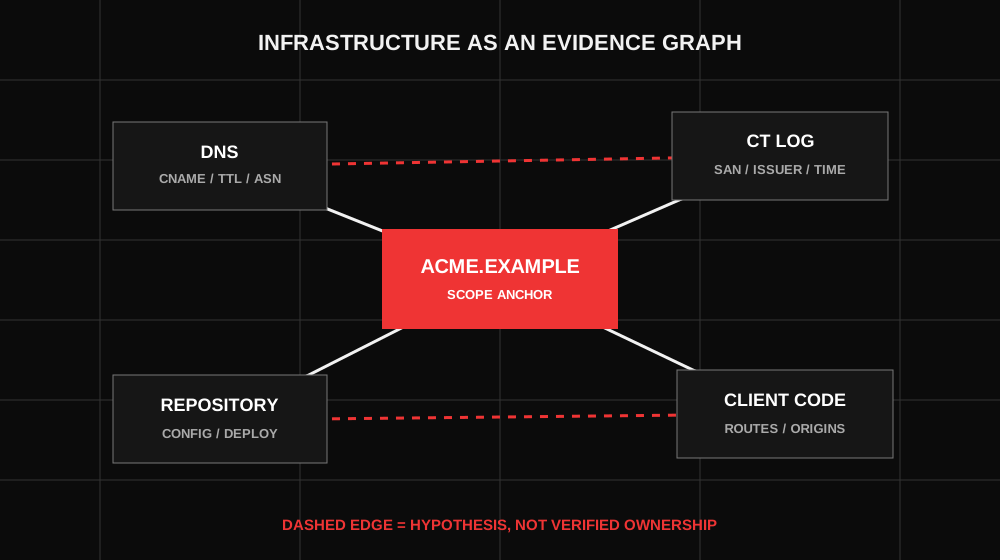
Reconnaissance is often described as collecting names and IP addresses. The difficult part comes afterward: deciding what the observations mean. An unfamiliar hostname can be a production service, an abandoned alias, a vendor tenant, or a historical artifact. A certificate can reveal a name without proving that a service is still deployed. A shared IP can connect unrelated customers. Good recon therefore looks less like a list and more like an evidence graph.
This method is for systems within an authorized scope. The examples use fictional acme.example names and synthetic observations. Passive clues can guide a review; they do not expand the permission granted by a program or asset owner.
Model observations, entities, and hypotheses separately
An observation is a recorded fact with a source and time: “status.acme.example had a CNAME to a vendor host at 10:20 UTC.” An entity is the thing a fact may describe: a domain, certificate, account, cloud resource, repository, or application. A hypothesis is an interpretation: “this hostname is probably a public status service controlled by Acme.”
The distinction matters because the same observation supports more than one hypothesis. A CNAME can indicate active delegation, but a dangling record can outlive the service. A certificate SAN may contain a staging name even if the staging service no longer resolves. Keep the edge in the graph labelled observed, inferred, or verified.
| Evidence | What it establishes | What it does not establish |
|---|---|---|
| DNS A/AAAA answer | A resolver returned an address at a time | Exclusive ownership of that address |
| CNAME to a vendor | A name delegates resolution toward a vendor | That the vendor account is live or claimable |
| Certificate SAN | A certificate was issued for the name | A reachable application exists now |
| Repository config | A committed file contains a hostname | The deployed system still uses that file |
| Client JavaScript URL | A bundle references an origin or route | The server accepts the route or trusts the caller |
This is consistent with OWASP’s attack-surface guidance, which treats domains, virtual hosts, exposed services, certificates, and non-obvious application paths as distinct pieces of the map.
DNS is topology with caveats
DNS provides a distributed naming system, not an asset inventory. An authoritative zone can contain A, AAAA, CNAME, MX, TXT, and other records with different operational roles; a recursive resolver can return a cached answer subject to TTL. RFC 1034 explains the domain tree and authoritative zones. A record’s presence is evidence of naming intent, while its target and current response are evidence about routing at the time of observation.
For api.acme.example, collect the exact queried name, record type, answer, resolver, TTL, and timestamp. Follow a CNAME chain rather than treating the first alias as an IP. Record both A and AAAA; a service may behave differently over IPv6. Compare authoritative answers with recursive answers when a discrepancy matters. Do not treat the apparent country or provider of an anycast or CDN IP as the application’s origin location.
Cloud-specific aliases complicate the picture. Amazon Route 53 alias records can route to AWS resources and appear to an external DNS client as ordinary records of the selected type; the alias property is visible through Route 53 configuration rather than a generic DNS answer. AWS Route 53 documentation describes the distinction. This is one reason to mark provider attribution as a hypothesis unless corroborated by owner-controlled records or configuration.
Wildcards create another attribution trap. If many random labels under a zone return the same address, a discovered hostname may be a wildcard response rather than a separately configured service. Compare the candidate with a deliberately nonexistent sibling inside an authorized domain and record the answers; matching answers are a clue, not final proof, because CDNs and load balancers can also converge on the same infrastructure. A wildcard certificate or DNS answer should reduce the weight you assign to a newly found specific hostname until another source corroborates it.
DNSSEC, when deployed, can authenticate that an answer or denial came through a signed DNS chain. It does not assert that the web service behind an address belongs to the organization you are investigating, nor that the content is safe. DNS authenticity and asset ownership are different claims. Similarly, an MX record identifies mail-routing intent, a TXT record may carry verification material, and a CAA record constrains certificate issuance; none of them alone proves that a particular web application is deployed.
Provider infrastructure also confuses IP-based grouping. A shared CDN address can serve many unrelated domains, while anycast can present the same address from multiple physical locations. Reverse DNS can name a provider edge rather than the customer origin. If you use ASN, geolocation, or reverse DNS in an evidence graph, label them as network context. They are not ownership edges. This is especially important when a tool paints a dramatic map: a precise-looking location pin can be a weak inference about the wrong machine.
Certificate transparency is a history of issuance
Certificate Transparency (CT) logs are publicly auditable, append-only records of certificate issuance. They are useful for discovering names in certificate Subject Alternative Name (SAN) entries and for constructing a timeline of certificate activity. RFC 6962 describes the Merkle-tree design and the distinction between a signed promise to log and later inclusion proof.
For each candidate name, record the certificate’s validity interval, issuer, SAN list, log timestamp, and whether the name currently resolves. Watch for wildcard names: *.acme.example says much less about the existence of any one host than a specific SAN does. Duplicate certificates and renewal automation can also make a name appear important simply because it appears often. CT can support a discovery hypothesis; it does not prove that a server was exposed, reachable, or in scope.
CT timestamps are not deployment timestamps
There are several clocks in a certificate record: the certificate's validity window, the time a log accepted a submission, and the time you observed it. They answer different questions. A certificate can be issued before a service is deployed, renewed after it is retired, or logged by more than one log. A precertificate can also appear in CT before the final certificate is served. RFC 6962 defines the signed certificate timestamp and inclusion model; it does not say that every logged SAN corresponds to a live endpoint.
For an investigation, keep the certificate fingerprint and log provenance rather than only the extracted hostname. Deduplicate by certificate identity before counting “activity.” If you see ten log entries for the same certificate, that may be one issuance event, not ten deployments. A timeline should say observed issuance when that is all it has. It should not silently become a timeline of services going live.
Repositories and client bundles reveal dependency shapes
Public code and documentation can reveal deployment assumptions: environment-variable names, status endpoints, CDN paths, service identifiers, or configuration templates. Search for exact domains, package names, and vendor-specific patterns, then inspect commit age and repository ownership. A fork or archived example is a weaker clue than a current repository controlled by the target. GitHub’s code navigation guidance describes how to follow symbols and references instead of relying on a single string match.
Client-side JavaScript is another dependency map. A bundle may contain an API base URL, a GraphQL operation name, or a feature flag. Treat these as references, not authorization. The application may have dead code, environment-specific branches, or server-side access checks. The safe next step is to document the candidate and confirm its scope before making active requests.
Strings are weak evidence until you follow the code
A minified bundle may contain production, staging, test, and library URLs together. A string search cannot tell which one the running application uses. Trace the value into the code path: is it assigned from a build-time environment variable, selected by host, guarded by a feature flag, or left in an unused branch? Source maps can clarify the module boundary when they are intentionally public, but their presence is not permission to treat every embedded URL as an in-scope target.
The same caution applies to repositories. A commit can be current while a file is only an example; a deployed service can run an older release than the default branch. Record the repository, commit hash, path, and line range that produced a clue. Distinguish owner-controlled repositories from forks, mirrors, and packages that merely mention the organization. GitHub's code-navigation documentation is a reminder to follow references and definitions rather than relying on one search hit.
If public code appears to contain a secret, do not paste it into a report, use it, or test it against a live service. Record enough context for the owner to locate and rotate it. The analytical point here is provenance, not access.
Turn clues into a testable architecture sketch
Suppose a fictional organization has these observations:
- DNS returns
app.acme.exampleas a CNAME to a CDN hostname. - A CT log shows
api.acme.examplein a recent SAN entry. - A public repository contains
PUBLIC_API_BASE=https://api.acme.examplein an example deployment file. - The current application bundle requests
/v2/sessionfrom that API origin.
Together they support a stronger hypothesis that an API sits behind the application than any clue alone. They still do not prove who owns the origin, whether the endpoint is in scope, or whether /v2/session accepts any particular method. A useful graph keeps the timestamps and provenance attached to each edge, then identifies what owner confirmation or permitted observation would resolve the remaining uncertainty.
A graph needs typed edges and time
Represent each clue as a record with at least subject, predicate, object, source, observed_at, and validity. For example, app.acme.example --CNAME_at_10:20--> vendor.example is different from Acme --owns--> vendor.example. The first can be observed from DNS; the second requires stronger evidence and may be false even if the DNS record exists. This typed-edge discipline prevents a diagram from turning association into ownership by visual proximity.
Time is part of the key. A CNAME answer at 10:20 and a repository reference from three years ago should not be combined as if they were simultaneous. Store the raw answer and resolver, then attach an expiry or recheck policy. DNS TTL describes caching behavior for an answer; it is not a promise that the resource will stay unchanged until the next audit. In dynamic infrastructure, two observations minutes apart may differ because of load balancing, deployment, or resolver geography.
Consider two competing explanations for an unfamiliar status.acme.example alias. H1: it is an active status page managed by Acme. H2: it is a stale alias left after a vendor migration. A recent owner-controlled documentation link and current application navigation would support H1. A missing vendor tenant and an old, unreferenced DNS record would support H2. Neither explanation should be promoted to fact solely because the CNAME exists. Write down what observation would discriminate between them before collecting more data.
Correlation is the trap in confidence scores
The exercise above adds weights to clues to make the reasoning visible, but the resulting index is intentionally not a probability. A certificate SAN, client bundle URL, and repository configuration might all come from one deployment template. Counting them as three independent confirmations exaggerates confidence. Ask whether evidence streams have different origins: DNS controlled by a zone owner, code controlled by a repository maintainer, owner documentation, and an observed application request have different failure modes.
A more formal model could compare likelihoods, $P(E|H_1)$ and $P(E|H_2)$, but those probabilities are rarely measured in recon work. The honest alternative is a short argument that names independent support, dependent clues, disconfirming evidence, and unanswered ownership questions. “Medium confidence because three sources agree” is weaker than “the live client requests this host, current owner documentation names it, and the DNS alias resolves; ownership of the vendor tenant remains unverified.”
Evidence-weighting exercise
Select fictional clues and see how a provisional confidence score changes. This is a teaching heuristic, not a probability or authorization decision.
A repeatable workflow
1. Anchor scope. Record the exact domains, programs, accounts, and exclusions supplied by the owner. A discovered neighbor is not automatically in scope.
2. Collect passive observations. Query permitted public DNS records and CT logs, inspect public owner-controlled documentation, and record timestamps, source URLs, and raw values. Avoid collapsing “seen in a log” into “currently live.”
3. Normalize identities. Keep hostnames, IPs, organizations, certificates, and vendor tenants as different node types. An IP may be shared; an organization name may be a string coincidence.
4. Form explicit hypotheses. Write “likely CDN front end because…” or “possible abandoned alias because…”. Attach a confidence level and a disconfirming test. Use evidence from independent sources where possible.
5. Verify only within scope. Any request that touches a service, account, or vendor endpoint should follow the program’s rules. Record what the active test actually observed, including error responses and timing, rather than converting an inference into a finding.
6. Revisit the graph. Infrastructure changes. TTLs expire, certificates renew, and deployment files become stale. A useful map has timestamps and can be updated without rewriting its history.
Make the result reproducible
A useful field note should let another researcher reconstruct the conclusion without copying a giant dump of hostnames. Preserve the query type, exact name, resolver or log, time in UTC, raw response or certificate fingerprint, and the transformation that produced each graph node. If you normalize a hostname, keep the original form too. If you collapse duplicate certificates, state the deduplication key. If you excluded wildcard or CDN-derived names, say why.
Negative results deserve care. “No A record from my resolver at 10:20 UTC” is a bounded observation. “The host does not exist” is a much stronger claim. Split-horizon DNS, regional routing, transient failures, and different resolver caches can all produce different answers. A NXDOMAIN observation should include which resolver answered and whether the authoritative zone was checked when that matters. RFC 1034 describes the distributed naming model that makes this distinction necessary.
The final deliverable is not a list sorted by hostname. It is a small architecture sketch with explicit uncertainty: which services are likely connected, which relationships are merely historical, which names are vendor-owned, and which question the owner should answer next. That is far more actionable than a thousand unlabelled lines of recon output.
The goal is not maximum hostname count. It is a map that another researcher or owner can audit: what was observed, what was inferred, what remains uncertain, and which permitted action would make the next answer more reliable.